
EYFS Intent, Implementation and Impact Statement
Intent
Here at Tibshelf Infant and Nursery School we have designed our Early Year Curriculum to ensure it is fully inclusive to every child. It recognises our children’s prior learning, both from previous settings and their experiences at home. We actively safeguard and promote the welfare of all our children. The principles of the Early Years Foundation Stage underpin our practice at Tibshelf Infant and Nursery School.
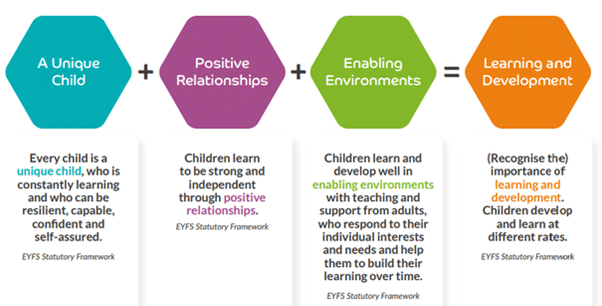
The Early Years Foundation Stage relates to the learning, development and welfare of children from birth to the end of Reception year as per the legal requirements set out in the statutory Early Years Foundation Stage Framework 2025. There are seven main areas of learning.
The Prime Areas:
- Personal, Social and Emotional Development
- Communication and Language
- Physical Development
The Specific Area:
- Literacy
- Mathematics
- Understanding the World
- Expressive Arts
At Tibshelf Infant and Nursery School, we believe that the Early Years Foundation Stage is crucial in securing solid foundations that children are going to build upon. It is our intent that the children who enter our EYFS develop physically, verbally, cognitively and emotionally whilst embedding a positive attitude to school and learning. We believe that children deserve to be valued as an individual where they feel loved and safe. We are passionate in ensuring that all children, regardless of any barriers they may face, achieve their full and unique potential. With all this in mind, we begin each new year and term by looking at the individual needs of our children and consider their different starting points.
At Tibshelf Infant and Nursery School, we recognise that oracy not only improves academic outcomes but is a life skill to ensure success beyond school, in life and future employment. Oracy develops children’s thinking and understanding, which in turn promotes self-confidence, resilience and empathy that supports the child’s well-being. Our enabling environments and warm, skilful adult interactions support the children as they begin to link learning to their play and exploration right from the start.
Our recently re-signed curriculum is designed to ensure high levels of engagement to maximise a high level of attainment. Our intent is to provide children with maximum opportunities for cross-curricular links and learning experiences, as well as promoting the unique child by offering prolonged periods of play. We follow children’s interests and ideas to foster a lifelong love of learning both in and outside of school. By the end of the Early Years Foundation Stage, our intent is to ensure that all children make at least good progress from their starting point and are equipped with the skills and knowledge to have a smooth transition into Year 1.
Implementation
Curriculum
Tibshelf Infant and Nursery School we have a 26 place Nursery (Ducklings Class) and currently two Reception classes (Butterflies and Ladybirds). The Nursery children have their own nursery building and outdoor space which is used to deliver all seven areas of the Early Years Foundation Stage curriculum. The teaching of these areas of learning is practical and playful with support and challenge from adults in class sessions, small group sessions and working with individuals. There is a combination of adult-led, teacher taught sessions as well as a wealth of stimulating continuous provision opportunities. Throughout all of these areas of learning and at the heart of the EYFS Curriculum are the “Characteristics of Effective Teaching and Learning”.
- Playing and exploring – children investigate and experience things, and ‘have a go’
- Active learning – children concentrate and keep on trying if they encounter difficulties, and enjoy achievements
- Creating and thinking critically – children have and develop their own ideas, make links between ideas, and develop strategies for doing things
At Tibshelf Infant and Nursery School, we strive to develop these key characteristics to give children the skills that they will continue to draw upon throughout their development
Reception children register in their own classrooms. Throughout the day there is a mixture of whole class taught carpet sessions within their own classrooms mixed with extended periods of time spent in Continuous Provision. During Continuous Provision the environment and resources have been carefully planned to achieve intended learning outcomes. There is emphasis and focus on skilled adults being available to extend vocabulary and purpose through high-quality interactions. During this time, adults may choose to work with small groups or individuals who have been identified, through robust formative assessment, as facing barriers to their learning in order to address these through intervention or catch up work.
We recognise the transition from Reception into Year 1 can be challenging. The timetable therefore changes throughout the year to help prepare children for more sustained periods of more formal learning in Year 1.
‘British Values’ are deeply rooted in our EYFS curriculum. We promote an environment that enables independence, understanding of our emotions and others, creative thinking, respect and tolerance. We foster the importance of democracy where each child feels heard and their opinion matters. A prime example, is our daily story session, whereby children can select between two stories they wish to listen to by using a voting system.
Every child is unique and brings a wealth of knowledge and life experience and we enhance their ‘cultural capital’ and build upon it through widening their experiences further. A few examples of this include visits from people with different occupations, a fire engine, attending Christmas Movie Night and joining the Colour Run. At Tibshelf Infant and Nursery School, we ensure that children experience the awe and wonder of the world in which they live, through the seven areas of learning. We give children opportunities to be curious, explore, try new things, and experiences.
Language, Communication and Oracy.
Many of our children start school and/or nursery well below the national average expectation for their age in many areas but in particular Communication and Language which underpins their ability to make progress in other areas of learning. Our learning environments are therefore language rich with children and adults engaging in high quality interactions. Adults model speaking in full sentences during back and forth conversations with the children and use ambitious vocabulary. This is complimented with the use of high quality texts, poems and rhymes.
Phonics/Early Reading
In EYFS our children begin their reading journey with access and exposure to high quality texts through daily story time. Key texts are often used a drivers to support other curriculum areas. Children in nursery are taught the vocabulary around books, understanding the story and how to turn the pages. We value the importance of children being able to tell a story verbally and have opportunity to develop their own vocabulary. During Nursery, our children work on and develop all the phase 1 skills in preparation for making a strong start with their phonics in Reception. We will then begin to follow a sequence of grapheme phoneme correspondence as identified in our DFE validated SSP programme through the direct teaching of daily phonic lessons. Teachers deliver high quality lessons where children are given the time to practise and apply blending and segmenting of new phonemes. Independent take home books continue to be precisely matched to a child’s individual ability to blend and read words at the different phase and set of decodable books. Running alongside their ability to read decodable words, children are taught ‘tricky words.’ Tricky words cannot be ‘sounded out’ as they break the phonetic rules of the English language.
Children are assessed at regular points throughout each phonic phase. This allows adults to quickly identify children who need support through extra intervention opportunities. By the end of Reception children should be working securely within phase 4.
We choose high quality texts to support topic themes as well as creating reading areas, ensuring that the full range of genres are on offer to maximise children’s interest and promote a love for reading.
Maths
At Tibshelf Infant and Nursery School, children develop their understanding of number, measurement, pattern, shape and space, we provide a broad range of contexts in which they can explore, enjoy, learn, practise and talk about numbers and shapes. Maths supports children in understanding what an important role shapes and numbers play in our everyday lives and how they develop our own understanding and help us to solve problems.
In Nursery, children develop a love of maths through games, songs, rhymes, and play using concrete manipulatives. There is a focus on the following counting principles; subitising, one to one correspondence, stable order and cardinal principle. Children’s fine manipulative skills are a focus to develop 1-1 correspondence so children count each object only once.
For Reception children, Maths is taught daily following the White Rose Maths scheme of work which is divided into 3 weekly units and supports children’s transitions into Year 1. Children are always very active in their learning, where the use of songs, visuals and concrete manipulatives are central to the development of their mathematical understanding. Mathematical experiences are continued into the Continuous Provision sessions, where teaching moments are scaffolded by the adults and activities are provided to consolidate and aid children to master new skills taught. The emphasis is for children to develop a deep understanding of number, including subitising, understanding quantities, number patterns, odds and evens and recall of number bonds and double facts up to 5 and 10.
Topics
In the Early Years, children explore the wider curriculum through both continuous provision activities and direct adult taught sessions. Please follow the links below to find out about the exciting themes and topics which run through our Nursery and Reception.
Nursery and Reception Long term plans
RE
At Tibshelf Infant and Nursery School, Religious Education is taught using the Derbyshire Agreed Syllabus 2025-30 which brings a renewed focus on a ‘worldviews’ approach, which is well integrated into our Early Years Foundation Stage. Whilst we realise that it is not statutory for Nursery children, we are keen to expose children to the themes through stories, resources and play-based learning. Children also learn about major festivals and traditions of other religions as appropriate both during RE lessons, topic sessions and during Assemblies throughout the school year.
PE
At Tibshelf Infant and Nursery School, children have access to a range of well-planned and stimulating activities both indoors and outdoors, that build on their fine motor and gross motor development. This is a balance of both adult led and child-initiated. Our planned curriculum for Physical Development is supplemented in Nursery with a weekly football session provided by Kixx Football Team. Reception children follow our Get Set for PE scheme of work which prepares children for transition into KS1.
Parent Partnerships
It is vital to us that we build positive relationships with our children’s families so that together, we can provide the children with a strong start to their education. We maintain regular contact with our parents through in person conversations, Tapestry, Parent activities such as Stay and Play sessions and Parent Lunches and Parents’ Evenings.
Inclusion
All children and their families are valued here at Tibshelf Infant and Nursery School. Children are treated as individuals and have equal access to all provisions available. All children are encouraged to achieve their personal best and planning is adapted to meet the needs of all groups and abilities. Early identification of special needs is crucial to enable staff to support the development of each child. Concerns are always discussed with parents/carers at an early stage and the schools SENDCO is available for further information and advice.
Assessment
Nursery children are assessed using the Birth to 5 framework to deem their individual starting points. Throughout the year, children continue to be assessed against their progress through the development ranges and check points about what is typical in all areas of learning. This allows our skilled practitioners to ensure planning is tailored to address any barriers children have.
Within the first 6 weeks that a child starts their Reception year, staff will administer the Statutory Reception Baseline (RBA) that is used alongside our own baseline assessments. Formative assessment in Reception is continuous, we assess and move the children on ‘in the moment, we use this information to ensure future planning reflects individual or group needs. Regular pupil progress meetings allow children to be identified quickly should they need extra support to help reach their full potential. We have twice yearly parents’ meetings to ensure parents/carers are informed of their child’s progress and next steps in their learning.
In the summer term of the Reception year teachers complete an assessment which is known as the EYFS Profile. This assessment is carried out by the Reception teacher and is based on what they, or other staff involved in the children, have observed over a period of time.
Children are assessed against the 17 early learning goals to indicate whether they are:
- Meeting expected levels of development
- Not yet reaching expected levels known as ‘emerging.’
This information is shared with parents as part of the annual end of year school report and parents can meet with the teacher and discuss this report. The outcomes of the EYFS profile are shared with the Year 1 staff to aid a smooth transition.
Impact
The Early Years Foundation Stage promotes teaching and learning to ensure children are ready for school and gives children the broad range of knowledge and skills that provide the right foundation for good future progress through school and life.
Our impact will be that, regardless of our children’s starting points they will make good progress relevant to themselves.
The majority of our children will achieve a Good Level of Development (GLD) and meet the Early Learning Goals at the end of their Reception Year.